The Prague Currency
The Prague currency page has been put together to give info about the currency here, the Czech Korun. The pictures below will show you what the Prague currency (banknotes) look like so, you’ll recognise them when you come here and understand their worth. Also check my Cash or Card post which gives you guidance on the cheapest way to get cash and how best to use cards.
Also listed on this page are different Prague currency exchange rate calculators with instructions on how to use Czech resources to see clearly what exchange rates are being offered by commercial banks and cambios so you may get an idea of where you want to exchange your cash. The last section deals with wire transfers, large currency transfers, credit cards and the “Euro”. If you intend on using an ATM here, take a look at the ATM section on this page. If arriving by train at the Hlavni Nadrazi then the Main Train Station Guide lists the ATM locations there.
Prague Currency – What the Banknotes Look Like
NOTE: Since July 2022 any note printed before the year 2000 is no longer legal tender. Check the Cash or Card post to see how you know if a note is old or new. The pictures on this post show the OLD notes.
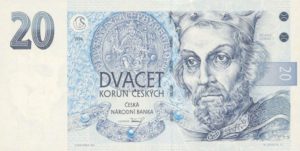
20 Korun Note
The 20kc banknote has ceased to be legal Prague currency and been replaced by the 20kc coin.
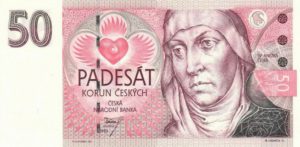
50 Korun Note
The 50kc banknote has ceased to be legal Czech currency and been replaced by the 50kc coin.
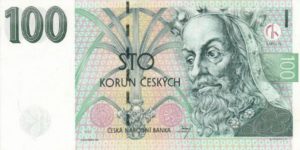
100 Korun Note
The 100kc Czech banknote is possibly the most popular in the Czech Republic. It’s Prague currency that is small enough to pay for a coffee and little knick knacks like sweets and ice creams etc.
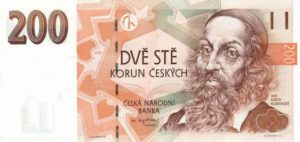
200 Korun Note
The 200kc banknote has become more widely used following the Czech currency devaluation of the Korun in 1997. I would expect to use this for lunch and get some change.
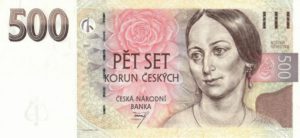
500 Korun Note
The 500kc Czech currency banknote is another good utility note where you’ll be able to get change reasonably easily. I wouldn’t try to pay for a coffee with it. Think of it as a 20 Pound note just not quite worth as much.
1000 Korun Note
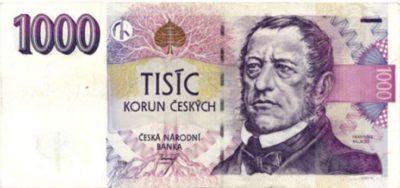
The 1000Kc is the first of the BIG banknotes. This is a kind of “lunch for two” note, taxi from the airport, round of drinks etc. I generally have a rule that I don’t try and break a note which is more than twice what I’m buying so to avoid complaints try and be spending at least CZK500 before you use one of these. You are bordering on credit card usage at this level.
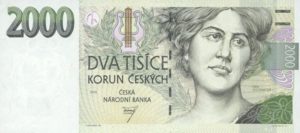
2000 Korun Note
This is a serious Prague currency. The 2000kc is more than the English 50 pound note and how often do you see one of those. Suitable for dinner etc but, I wouldn’t be carrying around too many of these. Certainly restaurants should be accepting credit cards for this level but, it’s an ideal opportunity to break one of these. CZK2000 is very often an option when withdrawing cash from an ATM so if you don’t want a single big note then ask the ATM for CZK1800.
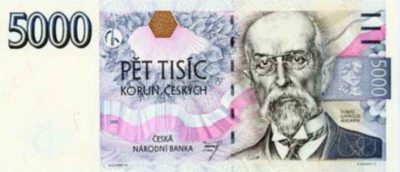
5000 Korun Note
Waiters will laugh at you if you try and pay with a 5000Kc note unless your bill is more than 2000kc. This is Prague currency that was widely used before the banking system became more reliable as many things i.e. cars and houses, were paid for in cash.
Prague Currency – Terminology and rules
Czech currency – WE SELL – this means we will sell you amount x of the local Czech currency in cash i.e. if you see a sign that says $=23.40 then for each U$ dollar you give them you’ll get that amount of local currency (minus charges).
Czech currency – WE BUY – this means that we buy amount x of the local Czech currency in cash and give you your own currency. This figure is always worse than the “sell” rate.
As a general rule if you see the buy and sell figures side by side, the bank or office with the least amount of difference between the Prague currency rates is generally the best although you do then have to watch out for “commission” or “fixed charge”. Commission is normally a percentage of the amount you want to change. Fixed charge is a set amount regardless of how much you want to pay and benefits people changing more money. Some places have a commission rate up to a certain amount which then becomes the fixed charge.
All numbers quoted on the boards like “0% commission” apply to cash only.
ATMs (cashpoint machines)
Many people are happy to use ATM’s as they are reliable, quite common and UK “Nationwide” Visa card users don’t pay commission so it works out to the best exchange rate. I’ve now written a guide on How to use a Czech ATM or check the Cash or Card post for links to Raifeissen ATM locations.
Credit Cards
Since 1996 the number of shops accepting credit cards has gone up to the point where it is now less likely for a shop NOT to accept them. Three warnings though. The first is that many shops will impose a limit like for electrical goods and I must show my passport if I want to buy something over 15,000 kc. The second warning is the risk of card blocking i.e. you try and use your card for something expensive and the transaction is refused. Unfortunately your card may now be blocked and you must contact the controlling bank for a security check. Sometimes it does not ask for the check and just says “refused”. I can help out here if you have an English visa/mastercard supported by Barclays. If this kind of card gets blocked then you can call +44 1604 614811 and reverse the charges. Other card holders should note their own contact numbers. The third warning is that not all restaurants accept all credit cards i.e. you may find that AMEX and Diners are not accepted. Always check with staff that they accept your method of payment before ordering.
The Euro
Since May 1st 2004 the Czech Republic has been a member of the European Union. It is however not a member of the Euro Zone and as such it is not required to use the Euro as its main currency. Currently there are a few places that take the Euro but these are limited to towns close to the German and Austrian borders. In Prague itself if a restaurant accepts the Euro it will state the rate but expect that any change is in Czech Korun. On my last visit to Cesky Krumlov, to pay in Euros was actually cheaper than to pay in Korun and you’ll also find this in the Vietnamese markets on the border. If a shop accepts Euros I would ask what the exchange rate is before paying as it’s normally a pretty bad rate i.e. Prague airport shops accept Euros but change is in Korun.
Cashback
This is just starting in the Czech Republic. Currently the CSOB bank in association with the Albert supermarket chain as well as the “post insurance” company offer the service. It’s bad enough trying to make yourself understood in Czech let alone trying to persuade a cashier in English that you want cashback so, I expect it will take some time to get fully working. It’s the same as in the UK. If you’ve purchased something and you want extra cash then you just make a separate transaction with the credit card. The Czech cashback system does not appear to support debit cards at present (at least one’s not supported by the CSOB bank).
My Own Guided Tours – Cheaper Than You Think!